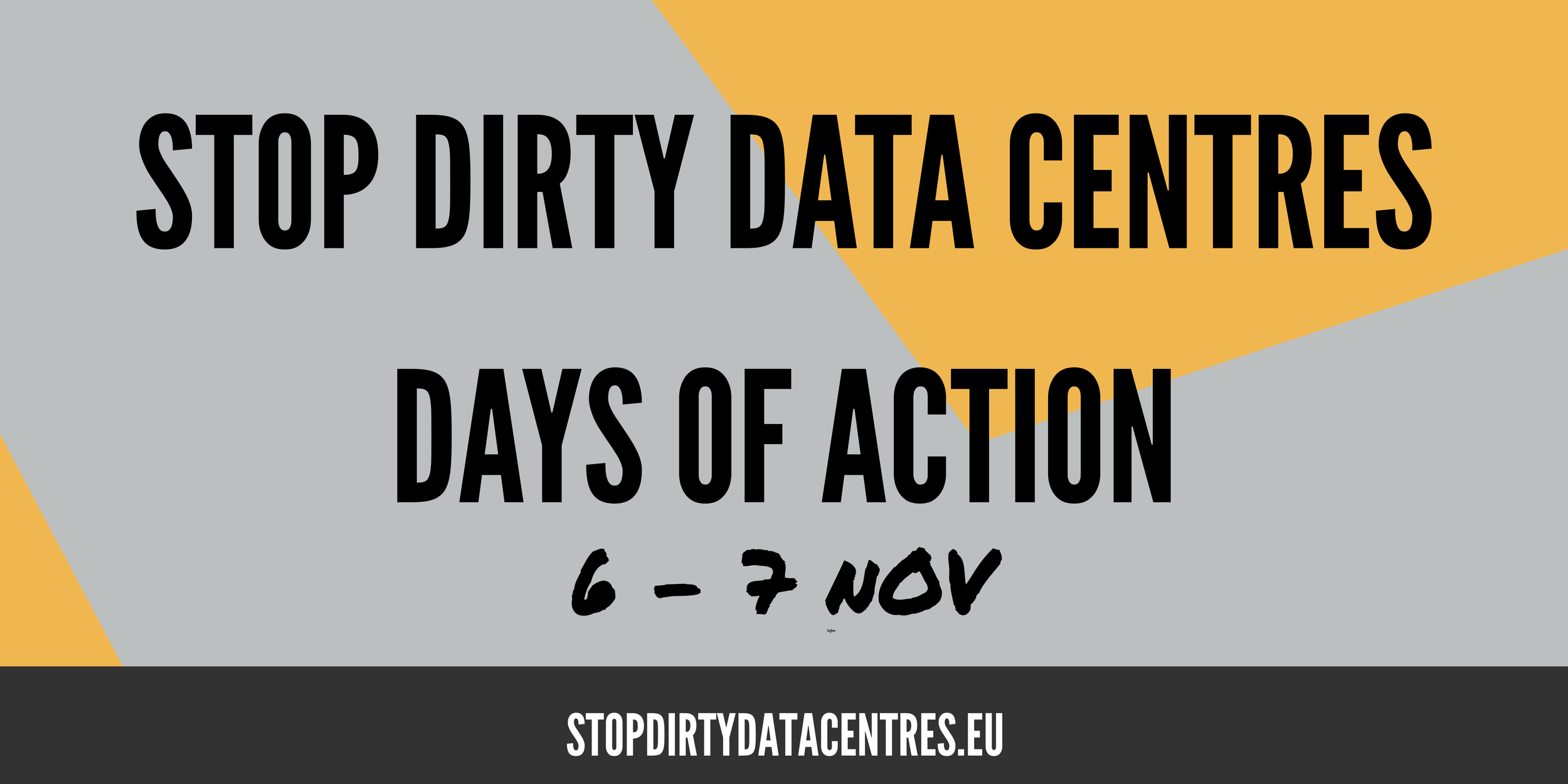
This weekend communities across Europe will rise to resist data centre proliferation. This Friday and Saturday, 6-7 November, campaigners will mark the #StopDirtyDataCentres European Days of Action, calling for a moratorium on data centre expansion across Europe.
The Days of Action come on the heels of US mid-term elections that saw the tide turn with a blue wave washing over. The rapid expansion of AI data centres was a ballot-box issue. Across the US, data centre expansion has ignited and united voters on what is often a politically fractured landscape. It is becoming a political question about land, energy, infrastructure and power.
Data centres have become a totem for growing public frustration with governments putting the interests of Big Tech billionaires and finance ahead of people struggling with the cost of living.
At heart, this is a debate about concentrated economic power. As Big Tech and Big Finance drive an AI build-out of unprecedented scale, (despite some Wall Street wobbles) governments are making every effort to support it, wrapped in a story about the best option for growth, and winning the global race for AI.
Yet, the benefits are hardwired to flow upwards and the host communities and society bear the costs.
The point of a moratorium is not to reject digital infrastructure. It is to stop today's AI infrastructure boom becoming tomorrow's entrenched technological power. There is now a crack in the political consensus.
What's the rush?
The scale, shape and colour of capital being mobilised for AI build-out has often been likened to the Gold Rush or the railway booms of the nineteenth century. Only now it's on a global scale.
Wall Street giants, hand in hand with the latest acronym to enter the lexicon, the Mangos: Meta, Anthropic, Nvidia, Google, OpenAI and SpaceX, are rushing ahead while leaders and lawmakers across the world place increasingly large bets in the race for AI dominance. Yet with every step, governments risk falling further out of step with the public. To echo Bert Hubert, software developer and what exactly is the rush?
Across Europe and the UK, governments are rewriting planning frameworks, allocating scarce resources and developing multi-year strategies to accelerate deployment. Land, energy, water, finance and political attention are all being redirected towards a build-out whose long-term economic benefits remain uncertain.
Calls to slow down are therefore welcome. Before committing vast public and environmental resources, we should know who controls this infrastructure, who profits from it, and whether the promised public benefits will actually materialise.
Closer to home, resistance is rising
Different levers of resistance are now being pulled. Whether it is residents in one of Europe's data centre capitals, Slough in the UK, or communities resisting proposed developments in places such as Jigginstown, in County Kildare in Ireland, local people are increasingly questioning whether the benefits promised by developers outweigh the costs imposed on communities (and on those further afield).
Even policymakers are beginning to reach for the brake. Across Europe, concerns about environmental impacts, energy systems, infrastructure capacity and planning processes are leading to greater scrutiny of data centre development. From Spain's Royal Decree imposing tighter oversight of data centres, to Finland's investigation into Google's environmental compliance, to Denmark's emergency measures pushing data centres to the back of the queue for grid connections, governments are showing growing willingness to challenge the assumption that every data centre proposal should be waved through.
As part of the #StopDirtyDataCentres Days of Action, Balanced Economy Project is urging councillors on the Cherwell District Planning Committee to reject the proposed £900 million EXOq "Innovation" District at Frieze Farm, Oxfordshire.
The development is being promoted as part of the UK government's AI-based growth strategy, building digital infrastructure and advanced technology capability through the Oxford-Cambridge Growth Corridor. Marketed as a flagship science and AI hub, the scheme would build on protected Green Belt land to accommodate major data centre and high-performance computing infrastructure.
We are concerned that the economic benefits are likely to flow overwhelmingly to investors, developers and large technology firms, while loss of Green Belt and agricultural land, increased flood risk, worsening congestion and air pollution, and the huge energy demands of hyperscale data centres, would further strain an already constrained electricity grid, driving up energy costs and heating the planet.
What needs to happen?
Ideally, do not pour more concrete while the ground is beginning to shift. A pause creates room to ask the questions that the rush has raced past: who owns this infrastructure, who funds it, who benefits from it, and on what terms?
Many of these questions sit at the heart of the EU's proposed Cloud and AI Development Act (CADA).
The European Commission rightly identifies Europe's dependence on Big Tech infrastructure. Yet its principal response is to accelerate the build-out of more data centres and AI infrastructure. New research out today by SOMO reveals how EU's data centre policy, which include the CADA, is opening the door to fast-track Big Tech's power.
Europe's proposed solution to dependence on Big Tech is to build more infrastructure that risks deepening dependence on the same ecosystem. If we run with logic for a moment, it's been well-documented that it's pretty difficult to run any AI model or training without at least one of the layers that make up the AI stack being part and parcel of Big (US) Tech.
And this dependency isn't the product of too little European data centre capacity. It is the result of who owns and controls the critical digital infrastructure. (Spoiler, it's the hyperscalers). So for Europe, accelerating the build-out without addressing the market conditions that enable this: like ownership, control and lock-in, means we won't escape concentrated power trap.
An EU monopoly is still a monopoly.
Swapping dependence on a handful of US firms for dependence on a handful of European firms leaves the same structural risks intact, particularly when ownership structures and financial interests frequently overlap.
The firms best placed to benefit from accelerated permitting, strategic status and public support are, unsurprisingly, the firms that already possess the scale, capital, data and locked-in customer relationships needed to dominate the market.
What we think needs to happen
No public support without ownership transparency. Disclose ultimate owners, major investors, anchor tenants, and long-term capacity agreements.
Make concentration a condition of approval. Require concentration and dependency assessments for strategic projects and acceleration zones.
Apply stronger safeguards to gatekeepers. Interoperability, portability, transparency, and non-discriminatory access obligations should accompany public support.
Tie public support to public benefit. Strategic status should depend on genuine social and economic value, not simply growth claims.
Use procurement to reduce dependency. Prioritise open standards, portability, multi-cloud capability, and credible exit strategies.
The key question is not whether Europe and the UK build more cloud and AI infrastructure. It is whether that infrastructure will be owned and governed in ways that disperse economic power or concentrate it further in the hands of a few.
Otherwise, there is a substantial risk that public policy becomes instrumentalised to help create a new generation of digital landlords, entrenching long-term extraction and private control over infrastructure on which the wider economy will increasingly depend. Until those questions are addressed, a moratorium on further data centre expansion is a reasonable and proportionate response.
So this weekend, as communities mobilise across Europe, the message is clear:
Stop Dirty Data Centres. Uphold a moratorium. Set strict conditions. Work out the fair digital economy that serves the public good.
Balanced Economy Project will be joining the Friends of the Earth Ireland planned demonstration in Dublin on November 7th. To join a mobilisation action that's happening closer to home for you, check out: https://stopdirtydatacentres.eu/