
Governments are racing to host AI data centres, offering tax breaks, fast-tracked planning and preferential grid access to some of the wealthiest corporations on the planet. Behind the dominant technology firms driving that race are the world’s largest asset managers, investing pension savings and sovereign wealth in infrastructure built on public subsidies, land and electricity grids.
A new paper from the Balanced Economy Project: “Licensed to Loot: Big Finance, Big Tech and the AI Infrastructure Grab”, shows how speculative investment, political influence and concentrated corporate power have fuelled an AI infrastructure race to the bottom whose costs fall on the public. As the paper notes, "speculative profit, political influence, and a small group of dominant firms have driven the pace and scale of the boom, while the environmental, social and financial costs have been pushed on to the public." Nobody in government has honestly asked who benefits and on what terms.
The research shows how a handful of firms like Nvidia, Taiwan Semiconductor Manufacturing Company (TSMC), Amazon Web Services (AWS), Microsoft and Google have locked up control across the AI supply chain, through deep financial partnerships such as Microsoft-OpenAI and Amazon-Anthropic. Meanwhile asset managers, including Blackstone and BlackRock, are channelling tens of billions of dollars into data centre infrastructure despite the hardware becoming obsolete in just three years.
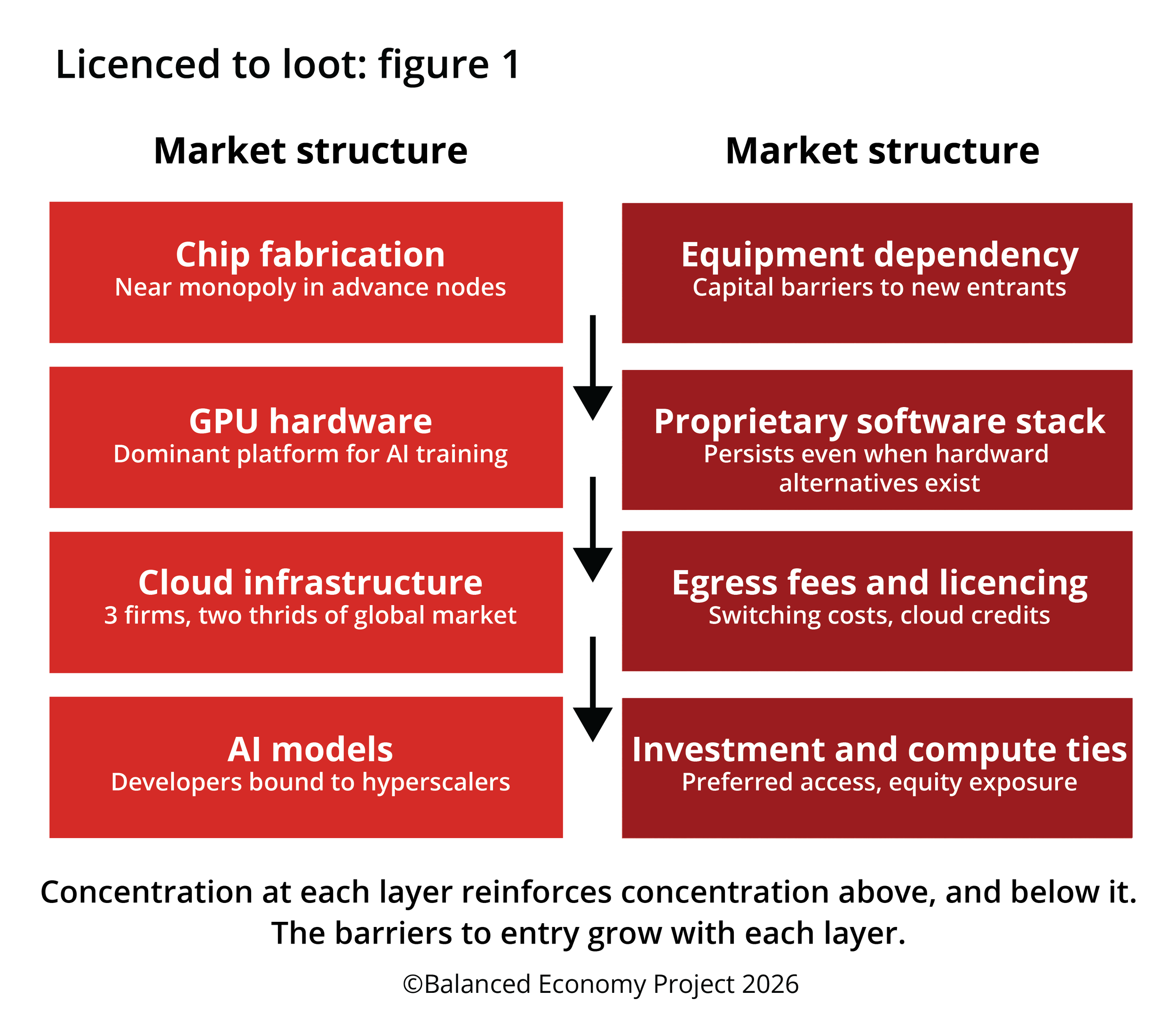
The consequences are already visible. UK data centre power demand is projected to rise from 1.5GW to over 8GW by 2030, with grid connection requests jumping from 41GW to 125GW in just seven months. In Ireland, data centres consume 22% of national electricity in 2024, with consumption expected to exceed all households combined by 2027. The results are water strain, land loss and planning decisions favouring the data centres. Governments also becoming dependent on foreign-owned platforms for public services and national data infrastructure.
Claire Godfrey, Executive Director of the Balanced Economy Project, said: "AI data centres are being pitched as essential to a modern economy, but our analysis shows they’re really the sharp edge of a strategy driven by Big Tech and Big Finance. A small number of companies are effectively creating their own demand, locking governments into reliance on them, while pushing the financial and environmental costs onto the public. We cannot build a fair or sustainable economy on infrastructure controlled by tech giants and funded by financial structures designed to extract returns from the public. A fair economy cannot rest on platforms owned by tech giants and financial models designed to drain public value for private gain. We deserve infrastructure that works for the public, not against it."
The Balanced Economy Project calls on governments to take structural action by tackling concentration in AI infrastructure, enforcing full transparency over ownership and investment terms, and ending the reliance on single vendors that have crept into public sector AI procurement. The paper also calls for embedding competition principles into every part of AI industrial policy so that public money does not entrench monopolistic corporate power. And until governance catches up with the scale of the build-out, the paper calls for a moratorium on new large-scale data centre approvals to prevent further lock in.
The full paper is available from the Balanced Economy Project here.
We need your help to hold powerful corporations to account and keep fighting to constrain corporate power. Donate to Balanced Economy Project today and help us build a fairer economy together.