
Big Finance and Big Tech are Looting the AI Boom
Our latest paper sets out how a manufactured investment cycle is concentrating power, straining public infrastructure, and leaving communities to pick up the bill.
The global rush to build AI data centres has fast become a story of concentrated financial power manufacturing a market that has captured governments and lawmakers, pushing risks and costs onto the rest of society. That is the argument at the heart of our new report, Licensed to Loot: Big Finance, Big Tech and the AI Infrastructure Grab, published last week.
The report documents how the AI data centre boom has been driven not by organic consumer demand but by a concentrated alliance between dominant technology corporations and the world’s largest financial actors. At every level of the AI supply chain, ranging from chips to cloud services, a handful of firms wield extraordinary and agenda-setting power.
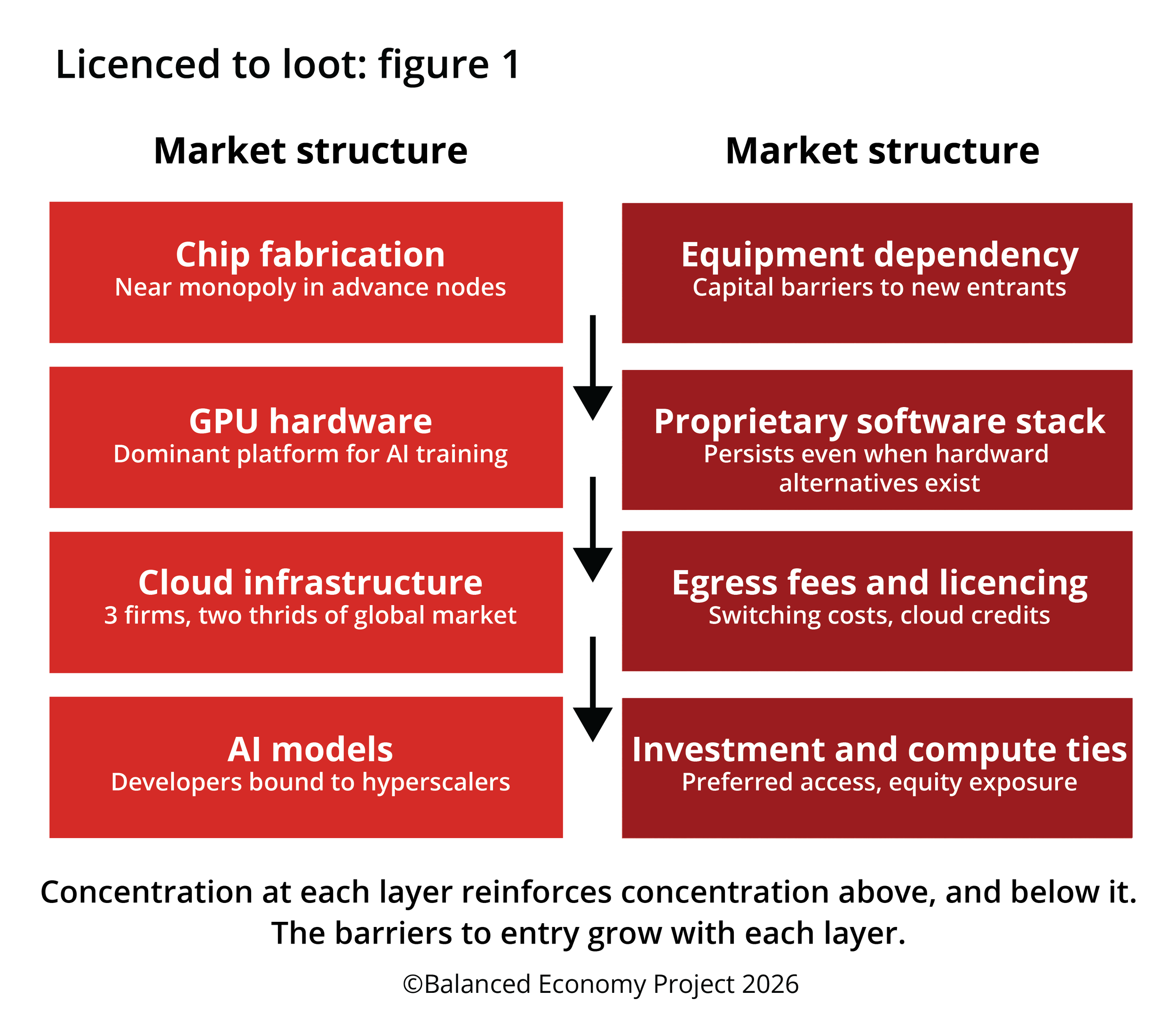
The UK’s Competition and Markets Authority found in 2025 that Amazon Web Services (AWS) and Microsoft each held between 30 and 40 per cent of UK cloud spending, with barriers in place to entrench customers and consolidate power.
As our report makes clear, the world’s largest and most powerful financial actors have aligned with dominant tech firms in a shared investment project. Blackstone, the world’s largest alternative investment firm, disclosed in 2024 that it held over $70 billion in data centre assets with the promise of a further $100 billion in the pipeline. BlackRock, the world’s largest asset manager, launched an AI Infrastructure Partnership with Microsoft and Nvidia with a view to mobilising up to $100 billion in investment for the nascent sector.
Governments, including in the UK, have obliged. The Starmer government has gone as far as to designate data centres as Critical National Infrastructure, fast-tracking planning arrangements for data centres and creating specific “AI Growth Zones” to aid economic growth. In Europe, the European Commission proposed fast-tracking environmental impact assessments for data centres, and capping community consultation at 90 days. This proposal followed documented lobbying from some of the world’s biggest tech firms including Microsoft and Amazon.
The consequences are already materialising. Housing developments in London have been temporarily halted because local grids have reached capacity, and, in Ireland, data centres were found to have consumed 22 per cent of national electricity in 2024. The International Energy Agency projects that global data centre electricity consumption could rival that of Japan by the end of this decade.
If those figures aren’t alarming enough, a Carbon Brief investigation published last month found that CO2 emissions from UK data centres could be “hundreds of times” higher than previous estimates.
The financial risk is equally stark, considering that the Bank of England warned last year that equity valuations for AI-focused technology companies were “materially stretched,” and on some measures “close to levels not seen since the dot-com bubble.”
In the face of these risks, however, resistance is growing:
Edinburgh City Council voted 51 to 10 to seek a moratorium on new data centre approvals. In the US, Senator Bernie Sanders and Representative Alexandria Ocasio-Cortez introduced legislation which would impose a nationwide pause on new constructions until protections for workers’ rights and the environment are in place. A poll across five European countries found that almost three quarters of respondents support mandatory renewable energy requirements for new data centres.
Balanced Economy Project is calling for urgent action before data centres bring about irreversible damage. First and foremost, governments must impose a conditional moratorium on new large-scale approvals until governance has caught up.
To mitigate the unbridled corporate dominance and control of AI infrastructure, we are calling for the break-up infrastructure-level concentration; the forced disclosure of ownership in the investment chain; an end single-vendor dependency in public procurement; and the embedding of competition principles in AI industrial policy.
As time marches on, the structural dependences being created now will narrow our collective room and capacity to act. The question is whether governments move before that capacity is gone.
The full paper is available from the Balanced Economy Project here.
We need your help to hold powerful corporations to account and keep fighting to constrain corporate power. Donate to Balanced Economy Project todayand help us build a fairer economy together.