Balanced Economy Project at Scotland’s Economic Festival: Why Tackling Monopolies Is Key to a Fairer Scottish Economy
The Balanced Economy Project spoke at the Scotland's Economics Festival. Claire Godfrey, Executive Director of Balanced Economic Festival, was in conversation with journalist Daniel Hind.
The Festival was organised to challenge conventional economic thought and promote a fairer, democratic economy. The session titled "Constraining Corporate Power" focussed on anti-monopoly, reducing corporate dominance, and increasing fairness in Scotland's economic system.
Our session dug into this head-on with the everyday reality of a handful of supermarkets controlling the grocery market, Big Tech shaping the digital infrastructure we all rely on and financial giants whose shareholders dominate entire sectors.
Food insecurity and costs have climbed sharply. A trolley of groceries costing £100 in November 2020 costs more £138 today, and is set to rise further with the latest war. Global shocks disrupting global supply chains play a role in rising prices. However, the untold story that drives the cost-of-living crisis is corporate greed in times of crisis.
The monopoly power enjoyed by dominant corporations enables them to use a crisis as an opportunity to jack up prices. Prices rise quickly and rarely fall back, and dominant corporations extract profits at every stage of the supply chain.
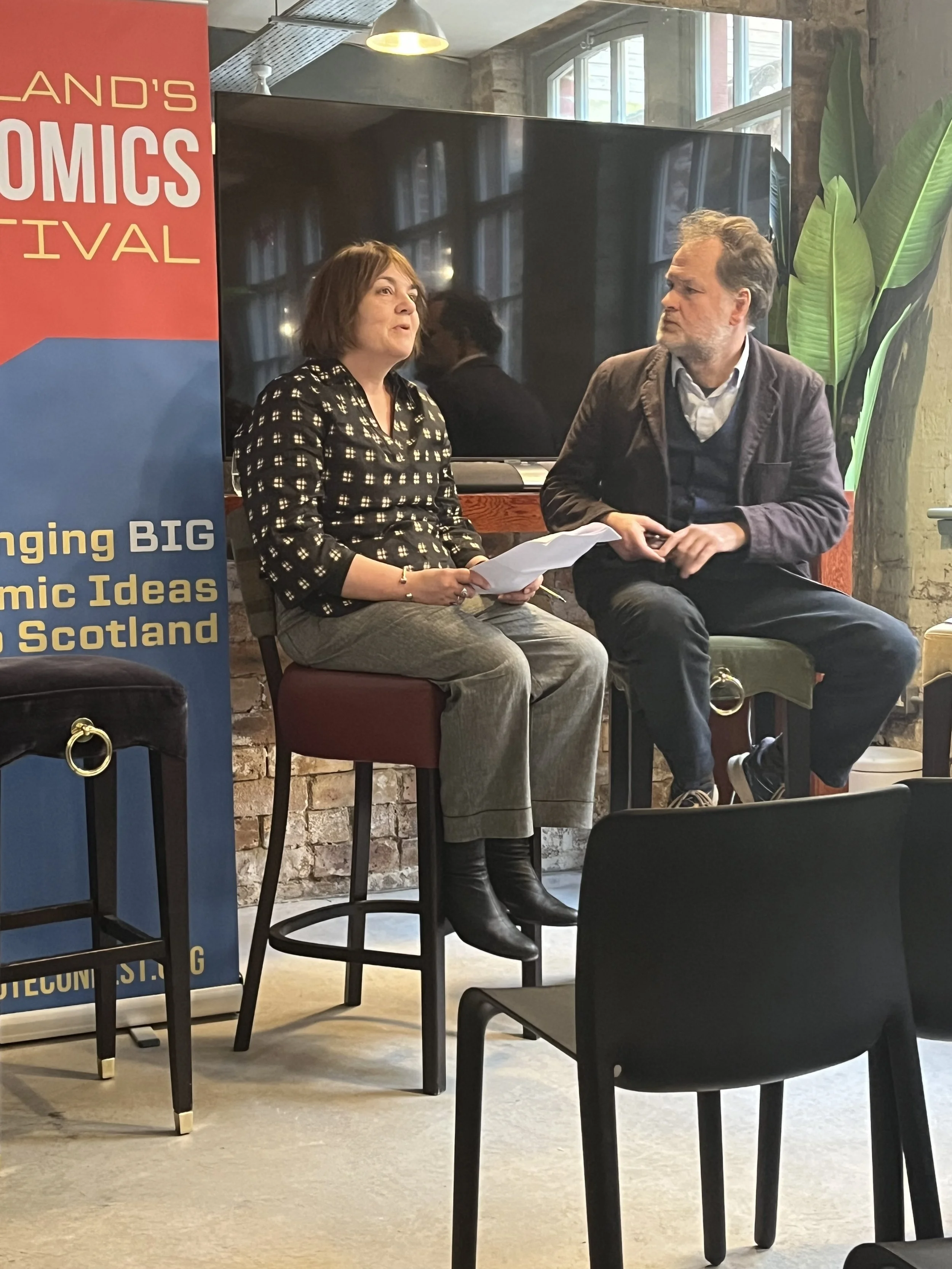
Claire Godfrey in conversation with Dan Hind
But the festival wasn’t about doomscrolling economics but understanding how we got here and what we can do next.
Competition policy was discussed, once designed to limit private power, has now been reshaped over decades into something that often supports corporate concentration in markets, rather than mitigating the growing corporate power of a few big corporations. Ideology, lobbying and institutional capture have all played a part.
The session focused on three areas of action:
1. Reclaiming the tools of the state to limit private power – using competition policy as it was intended, using its powers to break up firms that abuse the dominant position, block or undo harmful mergers, outlaw the same top shareholders controlling whole sectors, and prevent “killer acquisitions” in the tech sector.
2. Building democratic alternatives - creating public competitors in essential markets, such as “digital commons” (community-governed digital resources) as a provider for public digital infrastructure, or treating “natural monopolies” that provide public good or essential service as a public utility democratically owned and/or controlled by the public. Scottish Water – a publicly-owned company – demonstrates the value of this approach, investing 35% more per household than the privatised companies did between 2002 and 2018.
3. Strengthening civic power - Supporting workers, small businesses and citizens to challenge concentrated power, and building public awareness of how monopoly dynamics shape daily life.
Looking ahead to the Scottish elections, Scotland has practical levers it can pull now - whether resisting extractive datacentre expansion or using strategic public procurement to grow sovereign and open digital alternatives, and pushing Westminster and the CMA to take monopoly issues seriously, especially in local markets like care, veterinary services and gig economy labour standards.
The festival made one thing clear, which is how tackling monopoly power isn’t a niche policy debate but central to building a fairer, more resilient and more democratic Scotland. The appetite for that change is growing day-by-day as prices are going up, growth is stagnant, democracy is crumbling, and the cost of living crisis is soaring.
We need your help to hold powerful corporations to account and keep fighting to constrain corporate power. Donate to Balanced Economy Project today and help us build a fairer economy together.